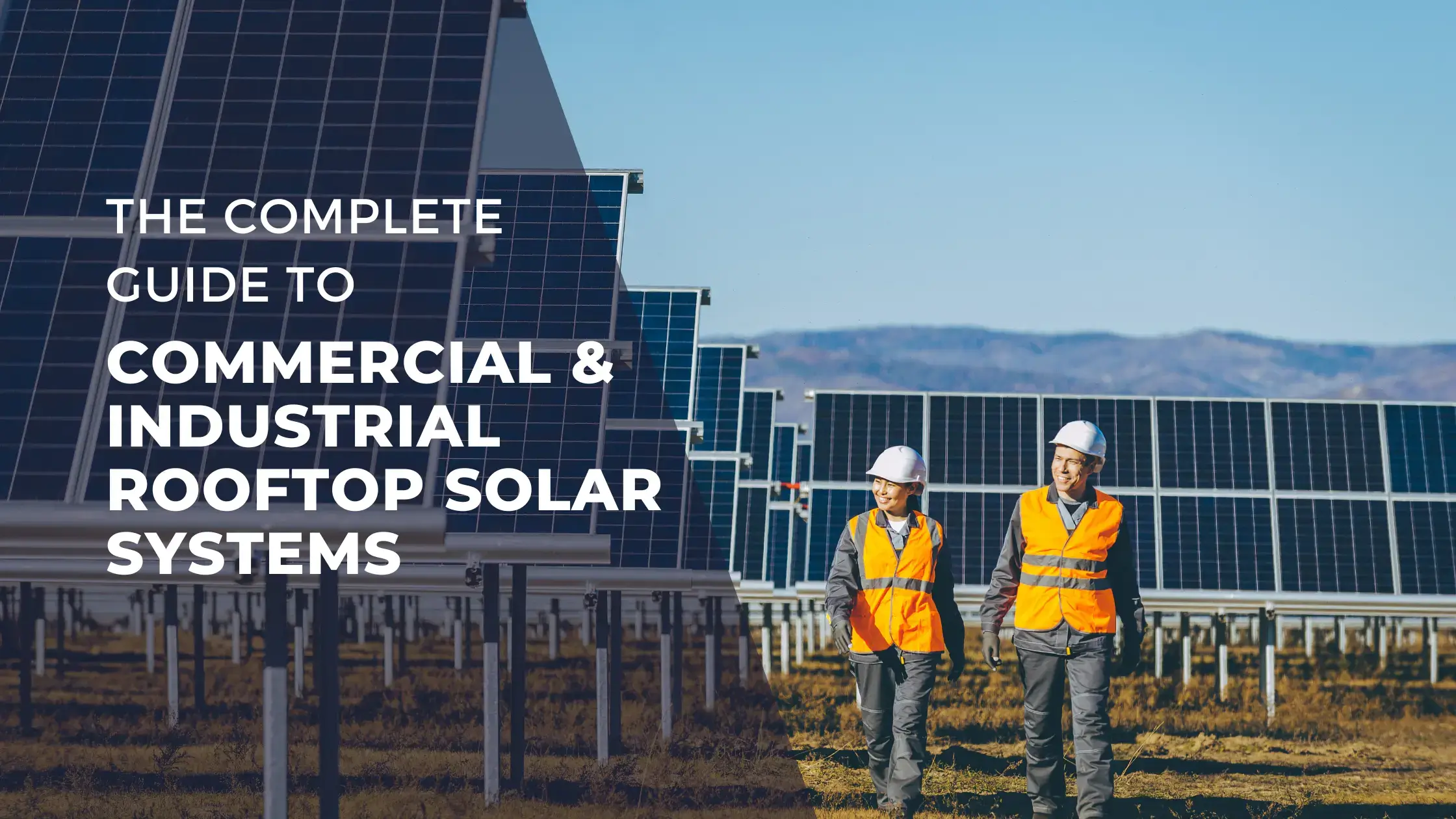
How Commercial & Industrial Rooftop Solar Can Boost Your Bottom Line
Commercial Rooftop Solar System
Companies are opening their eyes to the power of the sun. Like a gift from nature, they are opting to install solar panels at their offices, warehouses, malls, hotels and other commercial spaces. These photovoltaic systems harness the sun's rays when mounted on rooftops or ground areas. Acting as expert generators, small-scale solar arrays can produce up to 1 megawatt of clean electricity.
By adopting solar, businesses can take control of their energy costs. Commercial solar helps reduce bills, providing savings like a friend lending support in times of need. Commercial solar displays a commitment to clean power, appealing to eco-conscious consumers.
Industrial Rooftop Solar System
To power their energy-intensive operations, manufacturers are turning to industrial-scale solar farms. These large solar arrays are built near factories, production plants and industrial parks to generate over 1 megawatt of clean electricity. By directly feeding solar energy into the operational grid, industrial facilities can run their machinery, assembly lines and processes. Solar power helps heavy industries like auto and steel manufacturing dramatically cut their electricity costs. It also reduces carbon emissions for more sustainable operations. Industrial solar farms provide a smart long-term investment that creates both environmental and economic value.

Benefits of Commercial & industrial Rooftop Solar systems:
Reduce Electricity Bills
- The sun’s energy is free and unlimited, so you’ll rely less on the power grid.
- Generate your own clean electricity and become more energy self-sufficient.
- Protect your business from constantly rising electricity costs.
Increase Brand Value
- Today’s customers and partners really value eco-friendly businesses. Adopting solar shows, you care about sustainability and the environment.
- Attract environmentally conscious consumers to your green business.
Improve Employee Morale
- Employees feel good and work better when the company cares about the environment.
Attract Investors
- Investors like environmentally responsible companies because it makes the business more future-oriented.
Low Maintenance, High Returns
- Solar panels are like a reliable robot assistant – just clean occasionally like washing your car, then they provide years of free solar energy.
Future-Proof Your Business
- The world is shifting to renewable power.
- Going solar makes your company a leader ready for the future green economy.
- It’s like giving your business a sturdy spaceship to navigate any challenges ahead.
Solar System Applications for Manufacturing, Warehousing, Retail, Agriculture, and More
Manufacturing:
- Sun-powered factories can save money on energy while making products more sustainable. Robots and machines running on free sunshine!
Warehouses & Distribution:
- Solar panels on big warehouse roofs can provide clean electricity for forklifts and lights. Deliveries become more eco-friendly!
Retail & Offices:
- Customers and employees can enjoy comfortable spaces lit by sunshine. Solar creates a nice environment powered by nature.
Farms & Agriculture:
- Solar energy can operate equipment for irrigation and greenhouses. Crops can grow stronger with the sun’s natural power!
Major Energy Users:
- Hotels, hospitals, data centers can benefit from Solar’s savings and reliability. Lights stay on, machines run smoothly with the sun!
A Breakdown of Rooftop Solar System Components
Solar Panels
- Solar panels are the superheroes of the energy world. They soak up the sun’s rays like energizing fuel. The panels as tiny sponges, absorbing sunshine and converting it into power. They are the instruments that harness the sun’s limitless energy.
Inverters:
- These clever components are like translators. They change the electricity from the panels DC into the kind your business uses AC. They ensure everyone understands each other!
Mounting System:
- This is the backbone of your solar team, holding the panels securely in place. It can be on your roof, or even on the ground.
Monitoring System
- Think of this as the team coach, keeping an eye on everything. It tracks how much energy your system is producing, helping you see how well they’re working!
Solar System Myths vs. Realities: Separating Fact from Fiction
| Myth | Reality |
|---|---|
| Solar is too expensive. | Upfront cost can be higher, but long-term savings on bills, incentives, and tax breaks can make it worthwhile. Think of it as an investment! |
| Solar power isn’t reliable. | Modern systems are efficient and weather-resistant, with monitoring ensuring consistent power. Imagine panels working tirelessly rain or shine, like reliable employees! |
| Maintenance is too complicated. | Requires occasional easy cleaning, like washing your car. Designed to last years with low maintenance. Your solar heroes will do the work! |
| My roof isn’t suitable. | Experts can assess and suggest solutions, even ground-mounted systems if needed. Don’t let the roof shape hold you back from solar benefits! |
| I don’t have enough space. | Even small spaces can benefit. Carport solar or smaller rooftop systems can make a difference. Every sunshine bit captured helps! |
Choosing the Solar System that Fits You
Excited to start using the sun's power? But with different system types to pick from, which solar option fits your business the best? Let's explore your choices to find the perfect sunshine fit!
Roof-mounted: This classic choice uses your rooftop as the canvas for your solar panels. It's a popular option
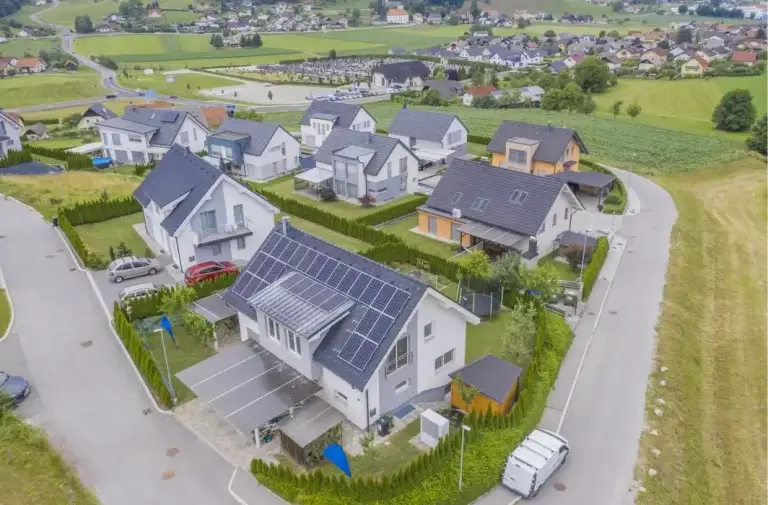
- Space-efficient: Takes advantage of existing infrastructure, maximizing land use.
- Cost-effective: Often requires minimal additional structures, reducing installation costs.
- Good sun exposure: Roofs typically offer clear views of the sky, optimizing energy generation.
However, consider these factors:
- Roof suitability: Your roof’s age, material, and orientation impact feasibility. Consult a professional for assessment.
- Shading: Nearby trees or structures can affect panel performance. Ensure good sunlight access throughout the day.
Ground-mounted: This option gives you more flexibility when space or roof suitability is a concern. Panels are mounted on sturdy structures on the ground:
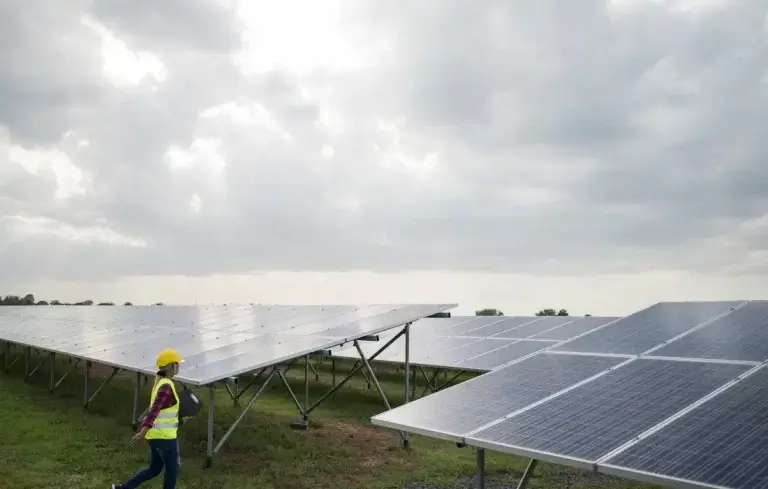
- Ideal for large spaces: Perfect for businesses with ample land or parking lots.
- Customizable placement: You can optimize panel positioning for maximum sun exposure.
- Easy access for maintenance: Easier to reach and clean panels compared to roof-mounted systems.
Things to keep in mind:
- Land use: Requires dedicated ground space, which might be limited for some businesses.
- Higher initial cost: Installation cost might be higher due to additional materials and structures needed.
Carport solar: This innovative option combines parking with power generation, making efficient use of space:
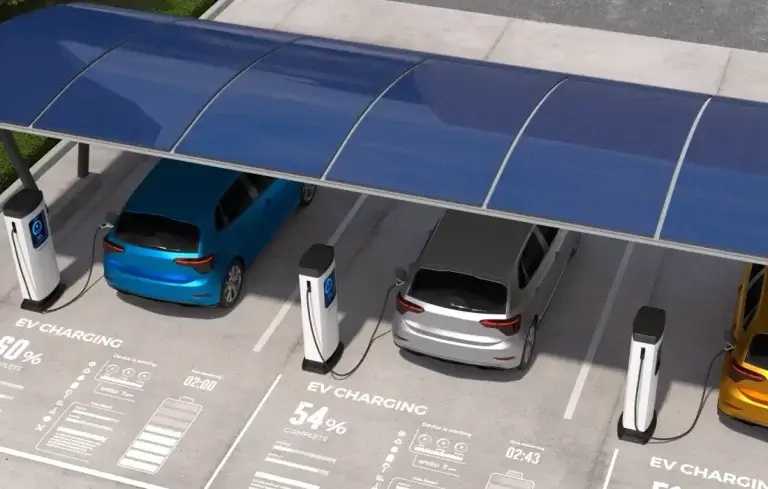
- Dual functionality: Provides shade for vehicles while generating electricity.
- Good for businesses with parking lots: Ideal for car dealerships, hotels, or office buildings.
- Aesthetic appeal: Can enhance the look and functionality of your parking area.
Remember:
- Feasibility depends on carport structure and size.
- Consider snow load or other weather factors in your region.
Choosing Your Solar Champion:
The best system type depends on your unique needs and constraints. Consider factors like:
- Available space: Roof size, land availability, or parking lot area.
- Budget: Compare installation costs for different options.
- Energy needs: Calculate your energy consumption to determine system size.
- Local regulations: Check for any restrictions or building codes.
An Overview of Large-Scale Solar Systems
Capacity: Industrial solar setups typically churn out electricity in the megawatt range - that's enough to power a whole city block! Compared to residential rooftop solar, these systems are gigantic.
Technology: Two main solar technologies are used based on preferences and purpose - photovoltaic (PV) panels and concentrated solar power (CSP) mirrors.
- PV panels directly convert sunshine into electrical juice using semiconductors, like the technology inside your calculator. With affordability and flexibility, PV prevails as the most common solar tech for major industrial facilities.
- Concentrated Solar Power (CSP) makes use of mirrors or lenses to focus sunlight onto a receiver. This heats fluid to generate steam powering a turbine that produces electricity. Although complex and space intensive, CSP achieves high efficiency and built-in thermal energy storage for when the sun sleeps.
Deployment: Industrial solar plants can be installed on open land near factories and warehouses, or integrated right onto rooftops of massive buildings.
Commercial & Industrial Rooftop Solar vs. Residential Rooftop Solar: Understanding the Key Differences
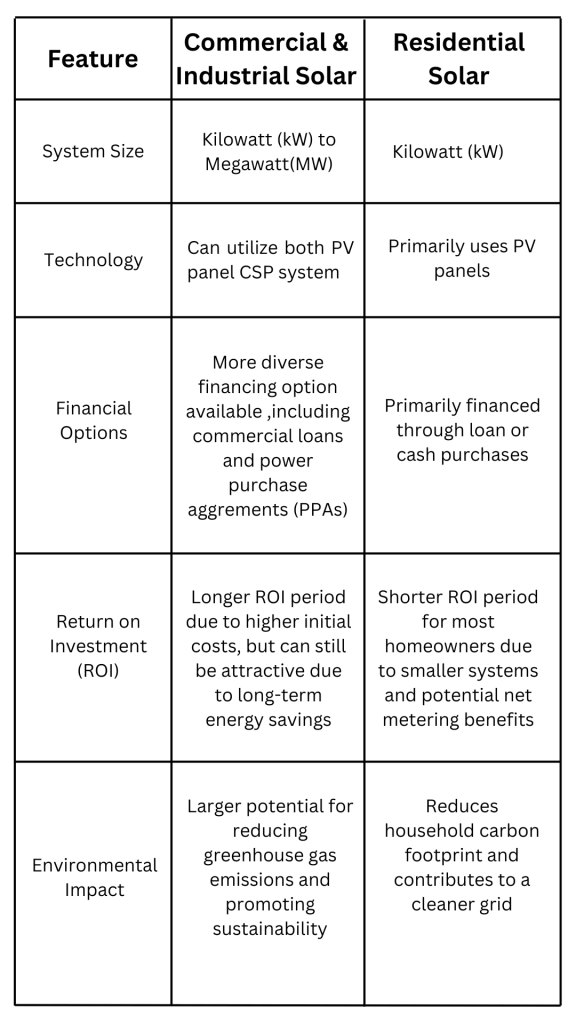
| Feature | Commercial & Industrial Solar | Residential Solar |
|---|---|---|
| System Size | Kilowatt (kW) to Megawatt (MW) | Kilowatt (kW) |
| Technology | Can utilize both PV panels and CSP systems | Primarily uses PV panels |
| Financing Options | More diverse financing options available, including commercial loans and power purchase agreements (PPAs) | Primarily financed through loans or cash purchases |
| Return on Investment (ROI) | Longer ROI period due to higher initial costs, but can still be attractive due to long-term energy savings | Shorter ROI period for most homeowners due to smaller systems and potential net metering benefits |
| Environmental Impact | Larger potential for reducing greenhouse gas emissions and promoting sustainability | Reduces household carbon footprint and contributes to a cleaner grid |
Conclusion
Going Commercial & Industrial Rooftop Solar Systems gives an awesome chance to succeed and help the planet. This can attract customers who value sustainability. Employees also appreciate companies that care about the environment. With many options like roof, ground, or carport systems, solar solutions exist for diverse business needs if space and sunshine access permit. By partnering with experts, even massive industrial facilities can adopt clean megawatt-scale solar to sustainably meet energy demands. For any business seeking to cut costs, empower employees, impress investors, and spearhead sustainability, solar power provides a sunny solution bright with potential.
Frequently Asked Questions (FAQs)
Monocrystalline silicon: Most efficient, best output per area, but more expensive. Good for limited space.
Polycrystalline silicon: More affordable, decent efficiency. Good for cost-conscious businesses with more room. The best choice depends on budget, space, desired output, and regulations.
Roof-mounted: Installed right on the roof to maximize space and minimize installation costs.
Ground-mounted: Best for ample land or parking lots, offers flexibility in placement.
Carport solar: Combines parking and power generation by shading vehicles. Good for parking lots.
Industrial panels often range from 270-500+ watts, higher than home panels (250-350W). More watts mean more power capacity.
Photovoltaic (PV): Most commonly, solar panels are directly used to make electricity. Concentrated Solar Power (CSP): Uses mirrors to concentrate sunlight and generate steam for power.
Commercial Rooftop Solar: Usually means systems for smaller businesses like offices, stores, or restaurants.
Industrial Rooftop solar: Typically refers to bigger systems for factories, manufacturing sites, or data centers.
Both use similar technology but may differ in size, power needs, and uses.


Comment
A Deep Dive into Commercial & Industrial Ro...
[…] Discover how commercial & industrial rooftop solar systems can reduce your electricity bills and contribute to a sustainable future. […]